Nature uses triggered structural changes to catalyze kinetically and thermodynamically challenging reactions.
O-lab reserach aims to mimic this mechanistic paradigm and then apply it to solve real world problems.

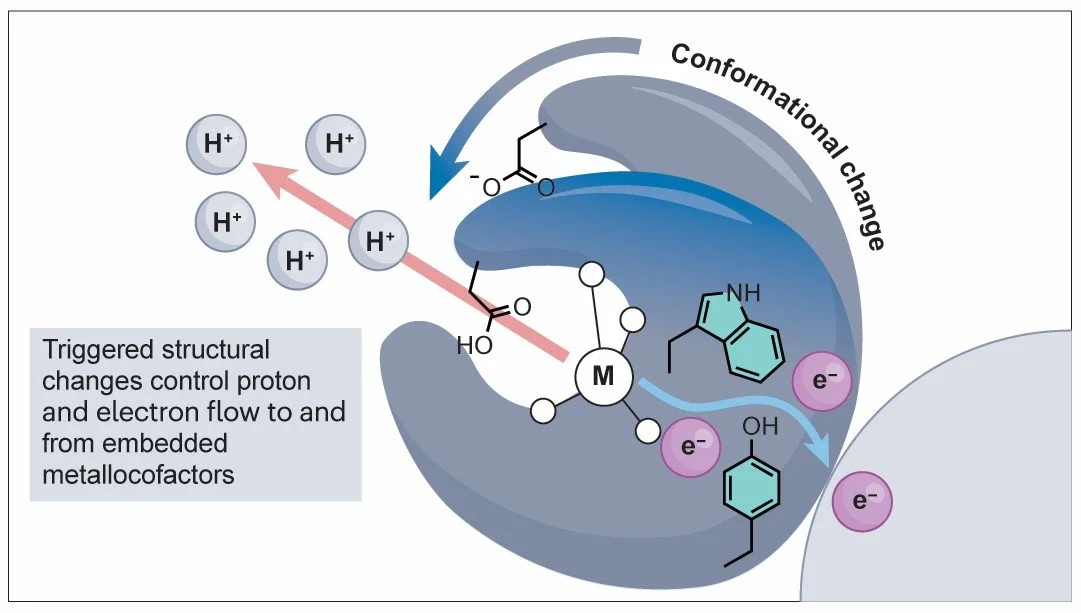
Biological systems have evolved to use triggered structural changes to control reactivity.
In metalloenzymes, these macroscopic structural changes often affect angstrom-level adjustments to the metallocofactor microenvironment.
In turn, these adjustments dictate the flow of protons and electrons, thus connecting mactrosctructural control with chages at the subatomic level.
We are inspired by this mechanistic paradigm as an elegant appraoch to controlling thero. But proving that in these multi-subunit, membrane-bound proteins is extremely challenging as it is often impossible to decouple conformational changes from catalysis.
Our lab creates, studies, and applies simplified synthetic and artificial systems with which to explore and exploit the link between molecular structural control and electronic structural control.